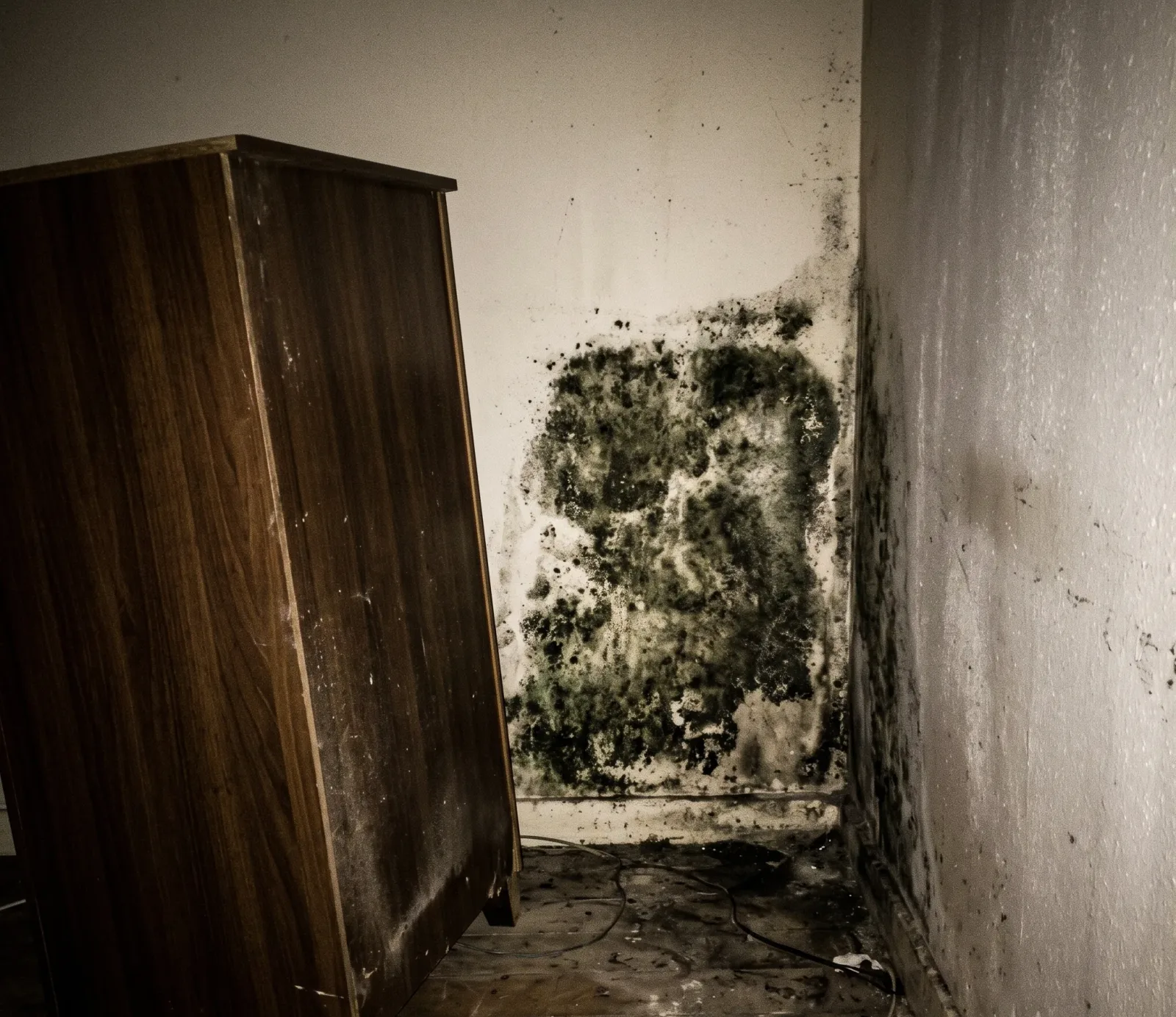
Why Mold Grows Faster in FL Homes
Why Fort Lauderdale's year-round humidity keeps mold growing long after the water is gone.
Fort Lauderdale's year-round humidity, often above 70 percent, lets mold grow indoors without any flooding at all. Condensation on cool surfaces near AC coils, block walls, and poorly vented bathrooms gives spores enough moisture to colonize in under two days. Controlling indoor humidity, not just cleaning up after storms, is what keeps mold from returning.
Why Fort Lauderdale Air Grows Mold Year-Round
Fort Lauderdale sits at roughly 75 percent relative humidity for much of the year, and that number rarely drops far even in the drier months. Mold does not need standing water to take hold. It needs moisture in the air and something organic to feed on. Drywall paper, wood trim, carpet backing, even dust on a shelf will do. Once spores land on a damp surface, colonization can start in under two days.
The science here is about vapor pressure, not rainfall. Warm outdoor air holds more water vapor than cool indoor air, so that vapor pushes toward any cooler surface it can find, a wall cavity, a closet, the back of a cabinet near an exterior wall. When it reaches a surface below the dew point, it condenses into liquid water. That thin film of condensation is often invisible, but it is enough for spores already resting on drywall or wood to begin feeding.
Fort Lauderdale runs warm and wet nearly every month, so relative humidity rarely gives a home a break the way it might further north. Outdoor air pulled indoors already carries a heavy moisture load before an air handler even starts working on it. That baseline is the reason mold questions here are less about a single flood and more about ordinary conditions that never fully dry out between rain events.
How Relative Humidity Turns Into Condensation
Mold needs three things: a spore already present, a surface with organic material to feed on, and enough moisture to let colonization begin. Spores are already in the air almost everywhere, indoors and out, so they are not the variable that changes outcomes. The moisture source is. Drywall paper, wood trim and dust on a shelf all qualify as food once dampness holds long enough for growth to start.
Oversized systems create a second problem that has nothing to do with leaks. A unit that cools a room quickly shuts off before it has run long enough to pull moisture out of the air. The room feels cool but stays humid, and that humidity settles into fabric, wood, and drywall paper on every cycle. Over months, that steady low-level dampness does more damage than a single fast leak, because nobody notices it building.
- Relative humidity measures how much moisture the air holds compared to what it could hold at that temperature. In Fort Lauderdale, outdoor relative humidity commonly sits high even on dry-looking days.
- Vapor pressure pushes moisture from the humid outdoor air toward the cooler, drier air inside an air-conditioned home. That pressure difference drives water vapor through walls, attics and window frames continuously.
- Condensation forms wherever humid air meets a surface colder than the air's dew point. Cold water pipes, AC ductwork and even interior walls near the Intracoastal can sweat during peak summer humidity.
- A slab foundation stays in constant contact with damp ground, and without a proper vapor barrier, moisture can migrate upward into flooring materials and baseboards over time.
- Salt air along Fort Lauderdale Beach and the Intracoastal corridor holds moisture readily, so window seals and door frames near the coast face a steadier moisture source than inland properties.
- Hurricane season, June through November, adds sustained tropical downpours on top of already-high baseline humidity, so indoor moisture control gets harder exactly when outdoor conditions are wettest.
Where Moisture Collects Inside a Slab Home
Concrete block, or CBS, construction is standard across Fort Lauderdale, from Coral Ridge to Melrose Park, and block holds moisture differently than wood-frame walls do further north. Block is porous. It absorbs humidity from salt air near the Intracoastal and releases it slowly into interior wall cavities, especially where paint or vapor barriers trap that moisture against drywall. A wall can look dry on the surface while staying damp inside for weeks.
Salt air compounds the problem for homes near the water, including canal-front properties in Rio Vista, Harbor Beach, and along the Las Olas Isles. Airborne salt holds onto moisture even in humid conditions, so surfaces near open windows or poorly sealed sliders stay slightly damp longer than they would inland. That extra dwell time is exactly what colonization needs. It is one more reason coastal-facing rooms often show growth before interior rooms do.
- A spore needs three things to colonize a surface: moisture, a food source, and time. Remove any one and growth stalls, which is why fast drying matters more than any cleaning product.
- Organic material is what mold actually eats: the paper facing on drywall, wood trim, carpet backing, even dust and skin cells trapped in an air handler filter.
- Biofilm can build inside AC condensate lines and drain pans in as little as a few humid weeks, giving spores a ready colony to spread from every time the system cycles on.
- Indoor air quality suffers once colonization is established, because active growth releases spores and off-gassing compounds continuously into the air the household breathes.
Indoor Spots Ranked By Colonization Risk
Flat roofs, common across commercial buildings and many condos in Downtown Fort Lauderdale and along Galt Ocean Mile, fail differently than pitched roofs. A pinhole leak or a seam that has separated after years of sun exposure lets water travel sideways along a deck before it ever shows a ceiling stain. By the time a resident sees discoloration, insulation above the ceiling may have been wet for weeks, giving mold a hidden head start behind drywall nobody has opened yet.
Tropical downpours during hurricane season, June through November, load the air with moisture even in homes that never take on standing water. Humidity spikes indoors every time a door opens during a storm, and it can take a slab foundation home hours to shed that extra vapor once the rain stops. Homes without a dehumidifier or a properly sized AC system hold that spike longer, giving airborne spores more time near damp drywall and baseboards.
| Location | Moisture Source | Risk Level |
|---|---|---|
| HVAC coil and drain pan | Condensation, clogged drain line | High |
| Flat roof deck and ceiling | Slow tropical downpour leak | High |
| Baseboards on slab foundation | Wicking from canal-side ground moisture | Medium |
| Window and door frames | Condensation from indoor-outdoor gap | Medium |
| Closets and low-airflow rooms | Trapped humid air, no air movement | Medium |
How Spores Travel Once Colonization Starts
Bathrooms and laundry closets without exhaust fans, common in older homes in Victoria Park and Poinsettia Heights, trap steam against tile grout and drywall long after a shower ends. Grout and unpainted drywall are organic enough, in the sense of containing cellulose and mineral binders mold can colonize, to support growth once biofilm starts forming in grout lines. A biofilm layer, once established, holds moisture against the surface even between uses, which is why grout mold returns faster than painted-wall mold.
Closed-up rooms make the problem worse. A guest bedroom or a closed den in a Twin Lakes North or Coral Ridge Isles home, shut off from the AC to save on cooling costs, loses the air circulation that keeps humidity even throughout a house. Stagnant humid air settles against the coolest wall in that closed room, usually an exterior wall, and stays there for days. Indoor air quality in that one room can differ sharply from the rest of the house.
Humidity Control As Year-Round Prevention
Humidity control is the only real defense, and it has to run continuously, not just after a storm. A correctly sized air handler that runs long enough per cycle to pull moisture out of the air, paired with exhaust fans vented outside rather than into an attic, keeps relative humidity in a range spores struggle to colonize. Homeowners near the New River or the Intracoastal, where ambient humidity runs higher, often need a standalone dehumidifier in addition to AC to hold that range.
A musty smell that lingers after a room has aired out for a day is a sign worth acting on. So is a soft or discolored patch on drywall near a window, or dark specks spreading across a bathroom ceiling faster than a quick wipe-down can keep up with. None of these confirm a species without testing, but each one points to a moisture source that has not been found and closed off yet.
What Makes This Climate Different
- Water-damaged materials must dry within 24-48 hours to prevent mold growth, per EPA guidance on moisture and indoor mold.
- No federal agency sets a numeric mold exposure standard; the EPA and CDC do not recommend routine air sampling for clearance testing.
- Florida requires a DBPR-issued Mold Assessor or Mold Remediator license for anyone performing this work for compensation under Chapter 468.
- Fort Lauderdale sits on sand over oolitic limestone bedrock, a coastal subsurface that holds groundwater close to the surface.
- Hurricane season runs June through November, layering tropical downpours on top of already-high year-round coastal humidity.
- Fort Lauderdale homes sit on slab-on-grade foundations, not basements, so ground moisture reaches living space directly through the slab.
Frequently Asked Questions
Why does mold keep coming back in my condo?
No. Fort Lauderdale's outdoor humidity regularly sits near 75 percent, and that moisture pushes into homes through concrete block walls, AC condensate lines, and poorly vented bathrooms. Mold can colonize a damp surface in under two days without any flooding or storm event. Continuous humidity control, not just drying up after rain, is what actually prevents it.
Does Fort Lauderdale's humidity cause mold without a leak?
Yes. When indoor relative humidity stays above roughly 60% for extended periods, surfaces like drywall and grout lines can reach the moisture level mold needs, even with no visible leak. Coastal humidity near the Intracoastal keeps that threshold within easy reach most of the year.
Why does my AC coil grow mold every summer?
Fort Lauderdale's outdoor relative humidity sits high most of the year, so any indoor space with a moisture source and organic material to feed on can start colonization within a day or two. Cardboard, drywall paper, and wood trim near a slow leak or a weak air handler are common starting points. Fix the moisture source first; humidity control alone will not stop it.
Can mold grow behind walls I can't see?
Yes, especially in canal-front and Intracoastal-facing homes where humid outside air meets a cooler wall cavity. Condensation forms inside the wall, the drywall paper stays damp, and colonization can spread for weeks before a musty smell or stain reaches the surface.
Is a musty smell in my Coral Ridge home mold?
A musty smell is usually off-gassing from active microbial growth, not proof of a specific species. In a Coral Ridge or Victoria Park home with no recent flooding, it often traces to a slow AC condensate leak or a humid closet with poor airflow.
Smell something musty? Get it checked now.
If you're seeing a musty smell, dark spotting, or a slab that stays damp anywhere from Coral Ridge to River Oaks, get it checked before it spreads further behind the walls.
Call (954) 910-2507